


Table of Contents


Kazakhstan’s National Bank launched Crypto Cards Project
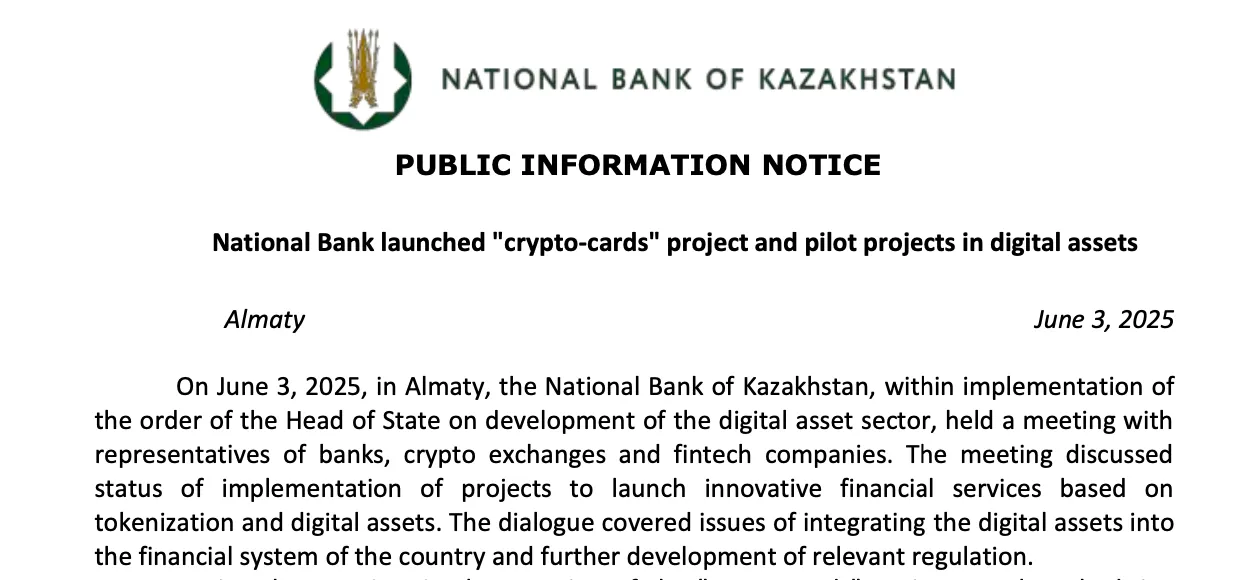
Source: National Bank launched "crypto-cards" project and pilot projects in digital assets
On June 3, 2025, the National Bank of Kazakhstan launched a "crypto-cards" project and several pilot initiatives in digital assets as part of a broader push to develop the country's digital asset sector1. The "crypto-card" allows consumers to make non-cash payments by linking traditional payment cards to crypto wallets managed by licensed providers at the Astana International Financial Center (AIFC). When a payment is made, the client’s digital assets are instantly sold on the AIFC crypto market, and the equivalent value is credited to the card in fiat currency, enabling seamless integration of digital assets into Kazakhstan’s existing payment infrastructure. The announcement also outlined plans for pilot projects such as issuing stablecoins backed by the national currency, tokenizing financial assets and real estate, improving systems for collateral and storage of digital assets, and expanding services for crypto asset exchange and custody.
Heechang (ASA, Four Pillars) - How can Central Banks build strategy Stablecoins
What if central banks aggressively pursue stablecoin initiatives? Central banks could implement crypto cards enabling consumers to pay at merchants, with stablecoins instantly liquidated on exchanges to settle transactions in real time. Central Banks can also streamline cross-border remittances, allowing international transfers directly through domestic-currency stablecoins, significantly reducing registration and procedural barriers. Additionally, stablecoins could form the foundation for platforms trading tokenized securities or real estate assets.
These scenarios are not merely hypothetical. These are the Kazakhstan’s central bank plans for this year, including the rollout of crypto cards.
As Simon Taylor emphasized, stablecoins are fundamentally platforms, and central bank-issued stablecoins inherently represent the highest level of trust for users. Therefore, it is crucial to strategically leverage this trust to maximize safety and adoption.


